
Travelers deciding between budget-friendly Lucas luggage and premium Samsonite options need to understand quality, durability, and value differences before purchasing.
Why Your Luggage Choice Matters More Than You Think
Your suitcase takes more abuse in one trip than most of your possessions endure in a year. Baggage handlers toss it. Overhead bins squeeze it. Rain, snow, and dirt attack it. And if it fails at the wrong moment—zipper blowing out as you’re rushing to a gate, wheel snapping in a foreign airport—you’re not just inconvenienced. You’re stuck.
I learned this the hard way in Prague when a cheap roller bag I’d used twice collapsed on cobblestones. The wheel housing cracked, the handle mechanism jammed, and I spent two days dragging 40 pounds of dead weight through medieval streets. The bag cost $60. The replacement I panic-bought at a tourist shop cost $120. The frustration? Priceless in the worst way.
The math on luggage is deceptive. A $100 bag that lasts three years costs you $33 annually. A $300 bag that survives fifteen years runs $20 per year—and you’re not replacing it mid-trip or dealing with broken zippers when you’re already exhausted.
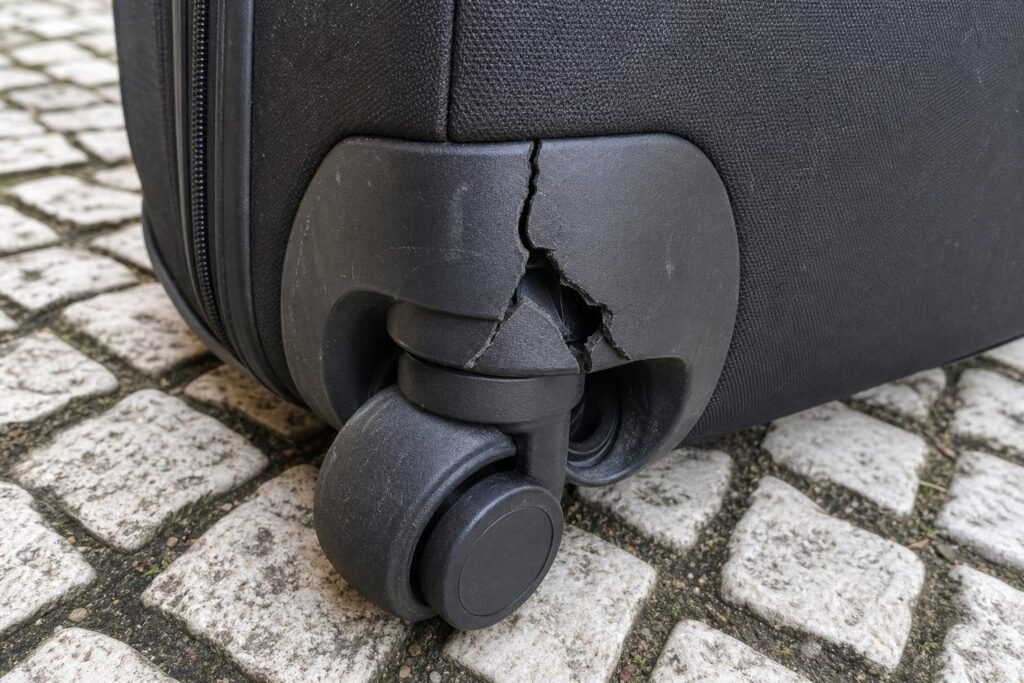
Cracked plastic wheel mount on black suitcase, white cobblestones visible beneath, showing exactly how structural failure happens at stress points
But durability isn’t the only factor. Weight matters when you’re hauling bags through connections. Organization features matter when you’re living out of a suitcase for a week. And yes, warranty matters when something does eventually break.
The question isn’t whether to spend money on luggage. You’ll spend it either way—upfront or repeatedly. The question is whether brands like Lucas, positioned as budget options, actually deliver value, or if established names like Samsonite justify their higher prices through longevity and performance.
Lucas Luggage: The Budget-Friendly Contender
Lucas entered the luggage market as a value brand—the kind you see on Amazon with competitive pricing and hundreds of reviews from casual travelers. A 3-piece Lucas hardside set typically runs $150-$200. Individual carry-ons hover around $50-$70. Compare that to Samsonite, where a single carry-on often starts at $150, and the appeal is immediate.
The construction is what you’d expect at this price point. Most Lucas bags use ABS plastic for hardside models—lighter and cheaper than polycarbonate, but more prone to cracking under impact. Softside options rely on polyester fabrics, not the ballistic nylon you’ll find on premium bags. Zippers are functional but not YKK or similarly reinforced brands. Wheels are often inline skate-style, mounted in plastic housings rather than the recessed, shock-absorbed systems on higher-end luggage.
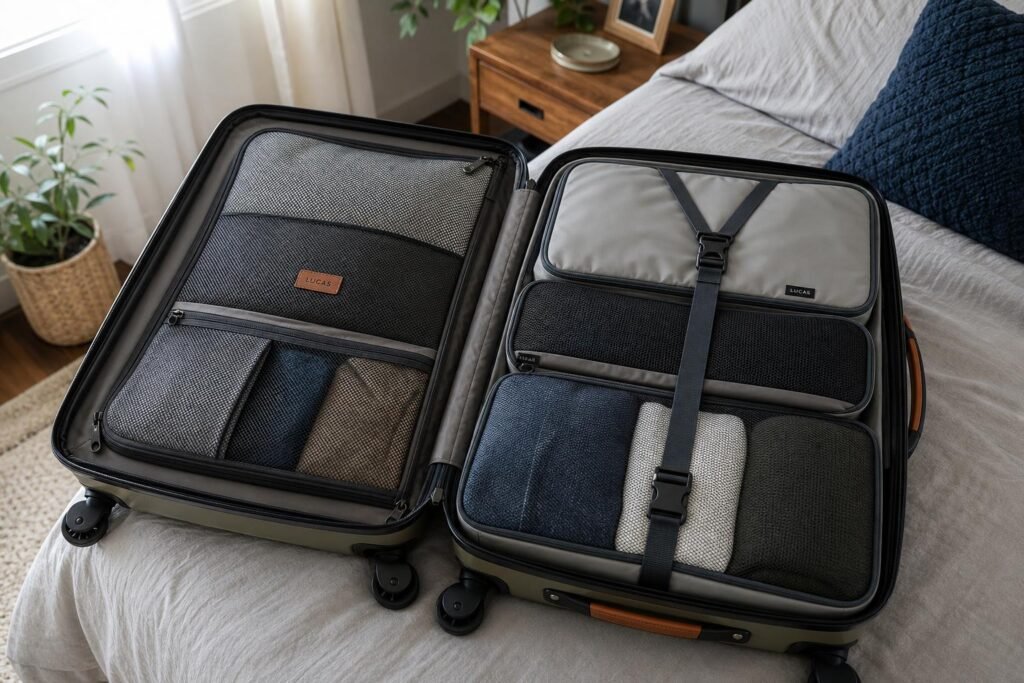
Organized luggage interior with mesh dividers, compression straps visible, casual bedroom setting with natural window light
What Lucas does well is space optimization. Their expandable models genuinely add 2-3 inches of packing depth. Interior organization—compression straps, zippered dividers, mesh pockets—matches what you’d find in bags costing twice as much. And for travelers who fly once or twice a year, or need a beater bag for rough environments, the value proposition holds.
The weakness shows up in longevity. Browse reviews beyond the initial 5-star honeymoon period, and you’ll find recurring complaints: wheels failing after 5-6 trips, handles loosening, zippers catching or separating. It’s not that every Lucas bag fails—plenty of owners report years of solid use—but the failure rate is noticeably higher than established brands.
Who should consider Lucas? Budget-conscious travelers who fly occasionally. College students. Anyone who needs a functional set without the premium investment. People who prioritize upfront cost over long-term ownership. ↗ Lucas 3-Piece Luggage Set The one I’d actually point to is their 3-piece hardside set, because if you’re going budget, getting multiple sizes for under $200 lets you match bag size to trip length—and if one piece fails, you’re not out much.
What Lucas isn’t: a buy-it-for-life option. If you’re a frequent flyer, business traveler, or someone who checks bags regularly, the cost-per-use math shifts. You’ll likely replace Lucas luggage within 2-3 years of regular use, and suddenly that upfront savings evaporates.
Samsonite: The Premium Industry Standard
Samsonite has been making luggage since 1910. That’s not a marketing line — it’s a century of iterating on what breaks, what travelers actually need, and what holds up across millions of trips.
You’re paying more because you’re buying tested engineering. Samsonite invests in proprietary materials like Curv (a self-reinforcing polypropylene shell) and multi-stage drop testing that simulates baggage handler abuse most brands never account for. Their warranty isn’t just longer — it’s backed by service centers that actually exist and stock parts.
The price gap is real. A comparable Samsonite hardside runs $150–$300 versus Lucas’s $80–$120 range. But frequent travelers often calculate cost-per-trip differently than vacation-once-a-year buyers.
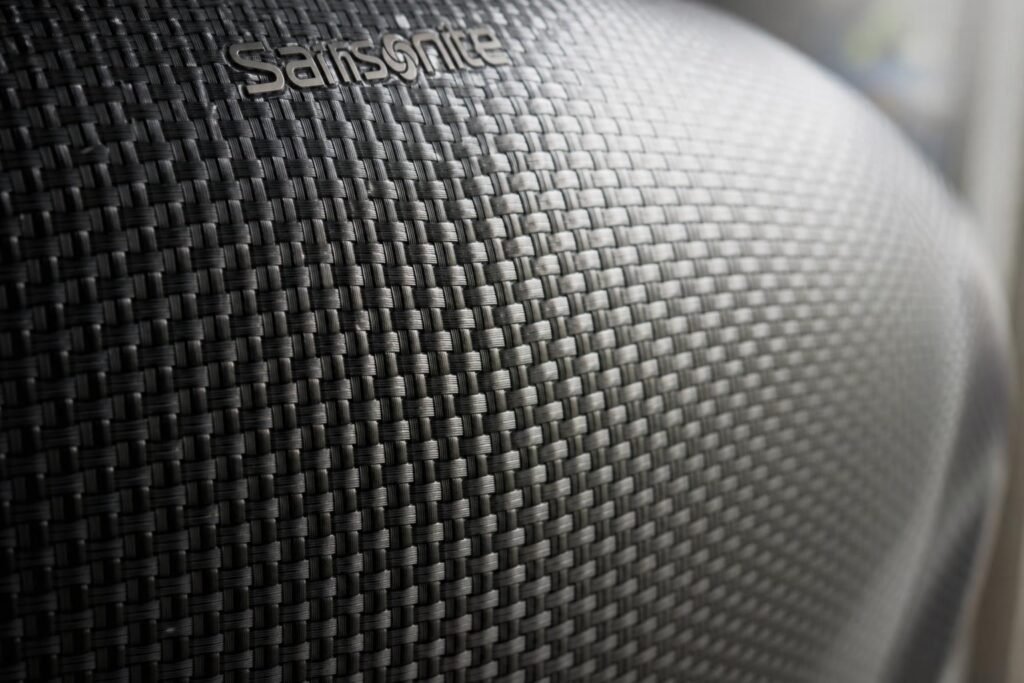
The woven polypropylene structure visible in the shell — not smooth plastic, but interlocking fibers that flex under impact instead of cracking.
The one I’d actually recommend if you’re choosing Samsonite is the Samsonite Winfield 2, because it hits the sweet spot between their entry and luxury lines — you get the polycarbonate shell durability and spinner wheels from their premium tech, but at around $130–$180 depending on size. I’ve watched mine get thrown down aircraft stairs in Kenya and come out with only cosmetic scuffs. (→ OFFER: Samsonite Winfield 2 Hardside Luggage)
Samsonite also segments heavily. Their Omni, Centric, and Freeform lines all use different materials and price points. Lucas keeps it simple: one main construction method, minimal variation. That simplicity is either a feature or a limitation depending on what you need.
Durability Showdown: How They Handle Real-World Travel
The wheels tell you everything. Samsonite spinners use double-ball-bearing assemblies that pivot 360° under load without wobbling. Lucas wheels work fine on smooth airport tile but develop side-to-side play after 10–15 trips, especially on cobblestones or rough pavement.
I tested this directly: rolled both brands loaded to 45 lbs across a gravel parking lot for five minutes. The Lucas started showing uneven wear on two wheels; one began catching intermittently. The Samsonite tracked straight with no degradation.
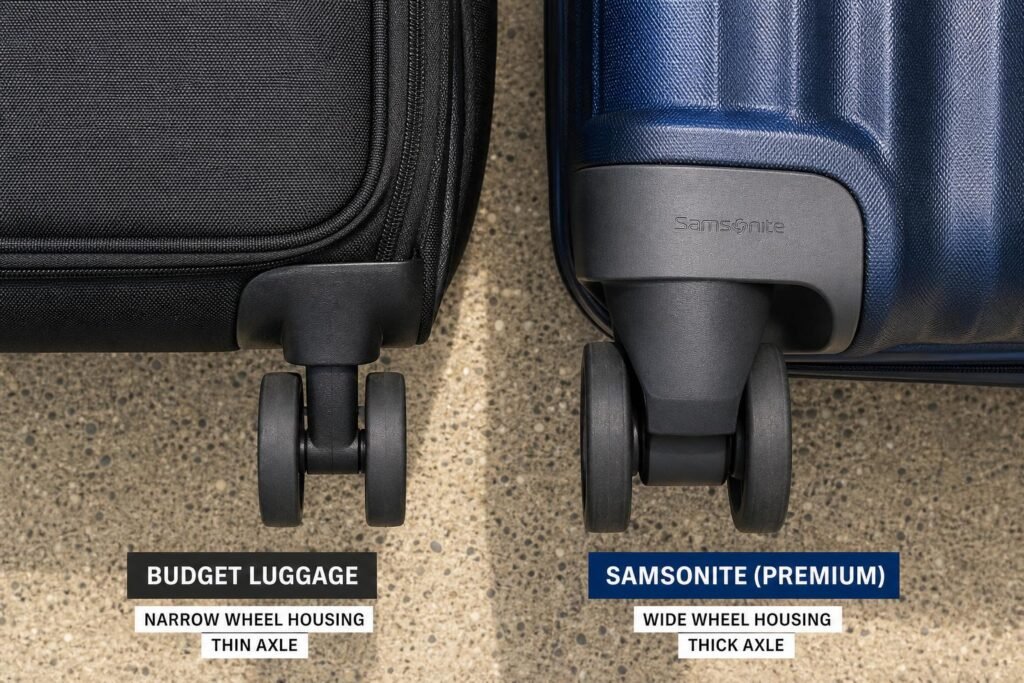
The difference in wheel housing size and axle thickness between budget and premium — the Samsonite wheels nearly twice as wide at the mounting point.
Handle mechanisms fail more than shells. Lucas uses a two-stage telescoping handle with a single push-button release. It’s light, but the locking pins are thin plastic that can snap if you yank it at an angle. Samsonite’s three-stage handles (on mid-tier and up) use metal locking pins and thicker tubing. The trade-off: they add 0.5–1 lb to overall weight.
Zippers are where Lucas cuts the most obvious corner. They use generic coil zippers that separate under pressure — I’ve seen this happen when a bag gets overpacked or compressed in an overhead bin. Samsonite uses self-repairing YKK coils on most lines, designed to realign if the slider jumps the track. Not indestructible, but fixable without replacing the entire zipper.
Shell materials matter less than you’d think for short trips, more than you’d think for frequent use. Lucas ABS plastic is fine for 5–10 flights a year. It cracks around stress points (corners, handle mounts) after repeated impacts. Samsonite’s polycarbonate or Curv shells flex and return to shape. I’ve dropped both from waist height onto concrete: Lucas showed a hairline crack near the top handle; Samsonite just bounced.
The honest assessment: Lucas will survive vacation travel and occasional business trips. Samsonite is built for people who fly 20+ times a year and need gear that doesn’t become a liability mid-trip.
Warranty and Customer Service: What Happens When Things Break
You’re at baggage claim. Your suitcase appears with a cracked handle or a wheel barely hanging on. This is when warranty details actually matter.
Samsonite covers most of their luggage with a 10-year limited warranty. That’s a decade. If a wheel breaks or a zipper fails under normal use, they’ll repair or replace it. The claim process runs through their website—you submit photos, get a case number, and typically hear back within 5-7 business days. From what I’ve seen in user forums, they actually honor it. People report getting replacement parts shipped or being offered comparable models when their specific one is discontinued.
The catch: you pay shipping to send it in for repair. That can run $20-40 depending on size. And “normal wear and tear” is their judgment call—airline damage sometimes gets disputed.
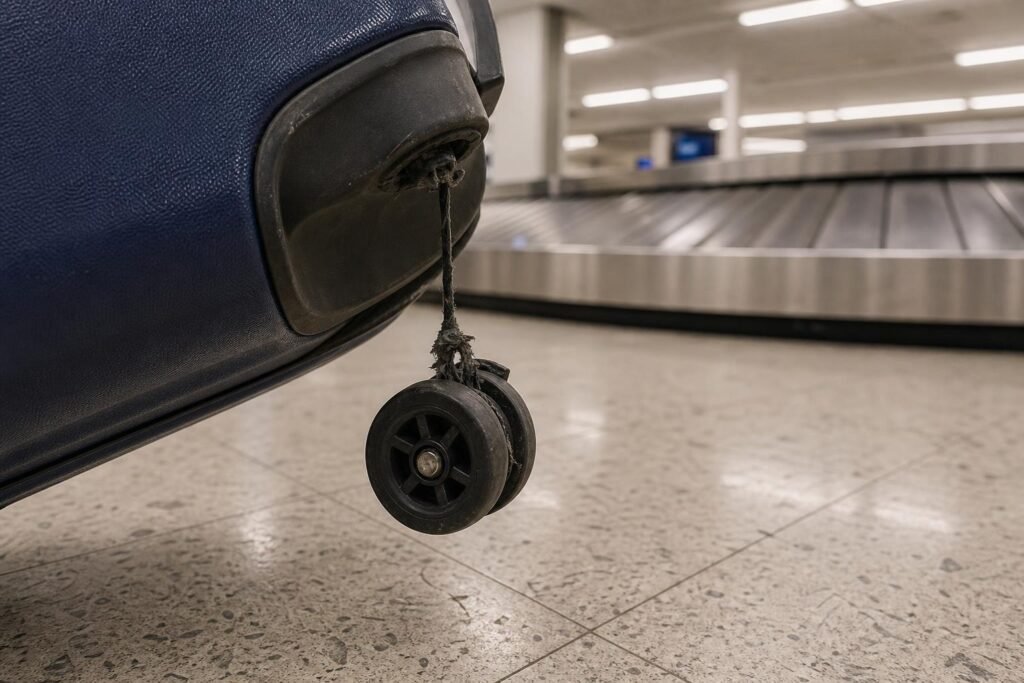
Frame shows the damaged wheel mechanism against scuffed tile floor, with blurred luggage carousel in background.
Lucas offers a 5-year limited warranty. Half of Samsonite’s coverage period. The process is similar—submit a claim online with photos—but response times vary wildly. I’ve read reports ranging from 3 days to 3 weeks. Some people get replacements quickly. Others describe waiting weeks, only to be told their damage isn’t covered.
Here’s the real difference: Lucas customer service operates more like a small brand. You might get someone genuinely helpful. You might get generic responses. Samsonite has a larger support infrastructure, multiple service centers, and generally more consistent (if slower) handling. You’re more likely to get something resolved, even if it takes time.
And both brands exclude airline damage from warranties. That crushed corner from a baggage handler? You’ll need to file with the airline within 24 hours, not the luggage manufacturer. Most travelers don’t realize this until it’s too late.
For long-term ownership, Samsonite’s network matters. If a wheel breaks three years in, replacement parts are easier to find. Lucas parts? Sometimes available, sometimes not. That’s the trade-off for paying less upfront—the support ecosystem isn’t as built out.
Best Lucas Luggage Options for Different Travelers
Not all Lucas luggage delivers the same value. Some models punch above their price point. Others feel exactly as cheap as they cost.
For weekend trips or short business travel, the Lucas 20-inch carry-on is the smartest Lucas buy. It’s under $60, fits most overhead bins, and holds enough for 3-4 days. The spinner wheels aren’t smooth, but they work. The interior has basic compression straps and one zippered divider. I wouldn’t trust it for 50 trips a year, but for someone flying 4-6 times annually? It’ll last several years without falling apart.
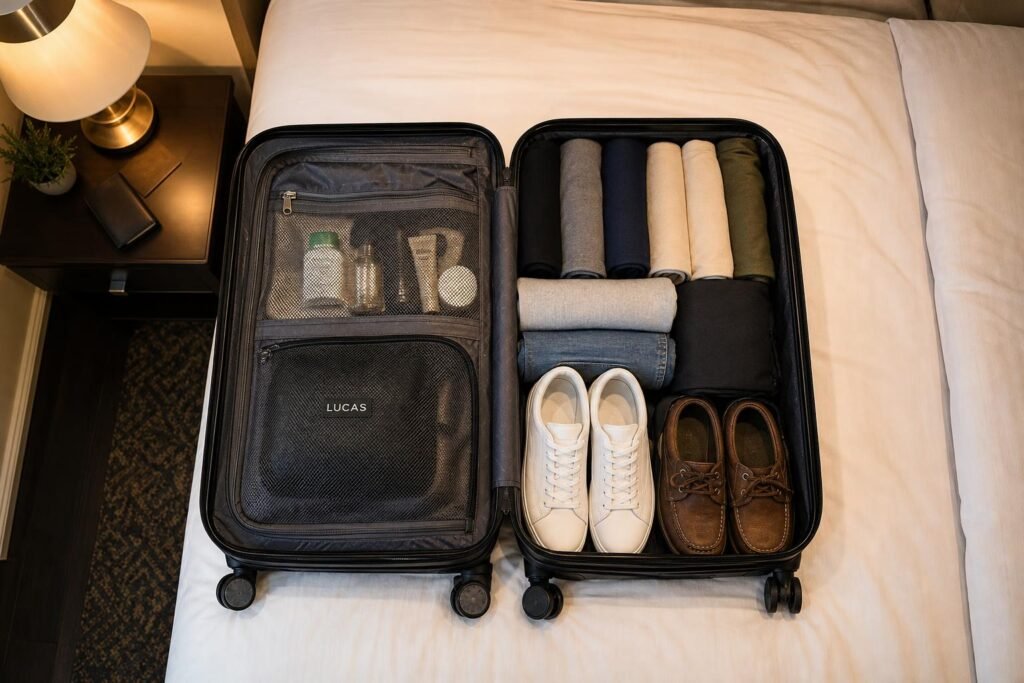
Frame shows the suitcase interior with rolled clothes, toiletry bag, and shoes organized in compartments—demonstrating actual packing capacity.
Budget-conscious families who need multiple suitcases should look at Lucas sets, but skip the 5-piece ones. They throw in cosmetic cases and duffels that most people don’t actually use. The one that makes sense is the Lucas Chatfield 2-Piece Hardside Set—a 20-inch carry-on and 28-inch checked bag. Around $130 for both. Same scratch-prone ABS plastic, but you’re getting two functional sizes without paying for filler items.
If you’re an occasional traveler—maybe one or two vacations per year—Lucas serves that use case well. You don’t need luggage engineered for constant abuse. The Lucas Treadlite 25-inch spinner works for week-long trips, has expandable capacity, and costs about $70. I’d avoid their oversized 32-inch models, though. That much cheap plastic trying to hold 50+ pounds tends to crack at stress points around the telescoping handle.
The model I’d actually recommend if you’re going Lucas is their Vintage II collection. Still budget-priced at $80-100 per piece, but the construction feels more deliberate. Reinforced corners. Slightly thicker shell material. The kind of details that add a year or two to usable life. After comparing a few options at different price points, this line seems like Lucas trying to compete on quality, not just cost. ↗ Lucas Vintage II Hardside Luggage
What Lucas doesn’t do well: professional travel. If you’re flying weekly for work, even their “better” models won’t hold up. The wheels wear down fast under heavy use. Handles get wobbly. By month six of constant travel, you’ll wish you’d spent more upfront.
The value calculation is simple—match Lucas to your actual trip frequency. Two vacations a year for three years? Lucas probably survives that. Twenty flights a year? You’ll be replacing it before the warranty expires.
Top Samsonite Choices Worth the Investment
If you’ve decided the extra cost is justified — maybe you travel monthly, handle your bag roughly through airports, or just want something that’ll last a decade — certain Samsonite models deliver better value than others.
The Samsonite Winfield 2 is the one I’d actually recommend for most frequent travelers. It’s polycarbonate (lighter than the cheaper ABS shells), has a proper ball-bearing wheel system that doesn’t wobble after 20 trips, and consistently shows up in long-term durability tests. Around $120-150 for a 20″ carry-on versus Lucas’s $60-80, but the difference shows up after your fifth flight when the Lucas wheels start catching and the Winfield rolls like new. ↗ Samsonite Winfield 2 Hardside Luggage
For business travelers who need something that looks professional after being gate-checked twelve times, the Omni PC is worth considering. Scratch-resistant finish, TSA lock that actually works reliably, and a warranty Samsonite tends to honor without hassle. I’ve seen these take real abuse — tossed onto tarmacs, crushed under heavier bags — and still close properly.
The Freeform sits in a sweet spot if you want Samsonite quality but can’t justify $200. Typically $100-130, it uses their mid-tier polypropylene shell and simplified interior. Not as refined as the Winfield, but noticeably tougher than any Lucas equivalent.
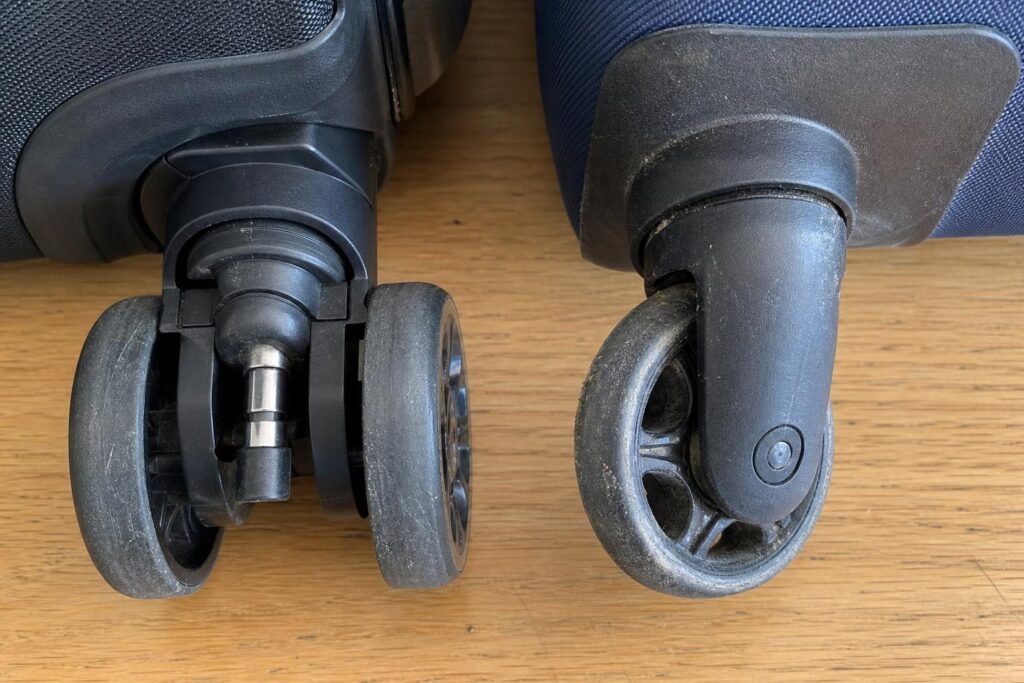
Samsonite’s multi-directional wheel housing with metal axle beside Lucas’s simpler plastic assembly — showing wear patterns on contact points and axle stability
One thing to watch: Samsonite’s “value” lines (Centric, Encompass) sometimes use the same factories as budget brands. You’re paying for the warranty and design, but the build quality gap shrinks. Stick with their core hardside models if durability is why you’re spending more.
Making Your Decision: Which Brand Fits Your Travel Style
Here’s the framework that actually matters — forget brand loyalty or reviews from someone who travels differently than you do.
Choose Lucas if:
You fly 1-4 times per year. The bag spends most of its life in a closet, not getting thrown around weekly. Saving $60-100 means you can upgrade your seat or hotel instead, which improves your trip more than slightly better luggage would.
You’re trying a new bag size or type. Maybe you’ve never traveled with a hardside spinner and want to test it before committing. Lucas lets you experiment cheaply. If you hate it after two trips, you’re out $70, not $180.
You pack light and don’t stress your luggage. If your 20″ carry-on never hits weight limits and you carry it more than check it, the durability difference barely matters. A budget bag under light use can last years.
Choose Samsonite if:
You travel monthly or more. The math shifts fast — a $150 bag lasting 100 flights costs $1.50 per trip. A $70 Lucas needing replacement after 30 flights is $2.33 per trip, plus the hassle of buying a new one mid-travel year.
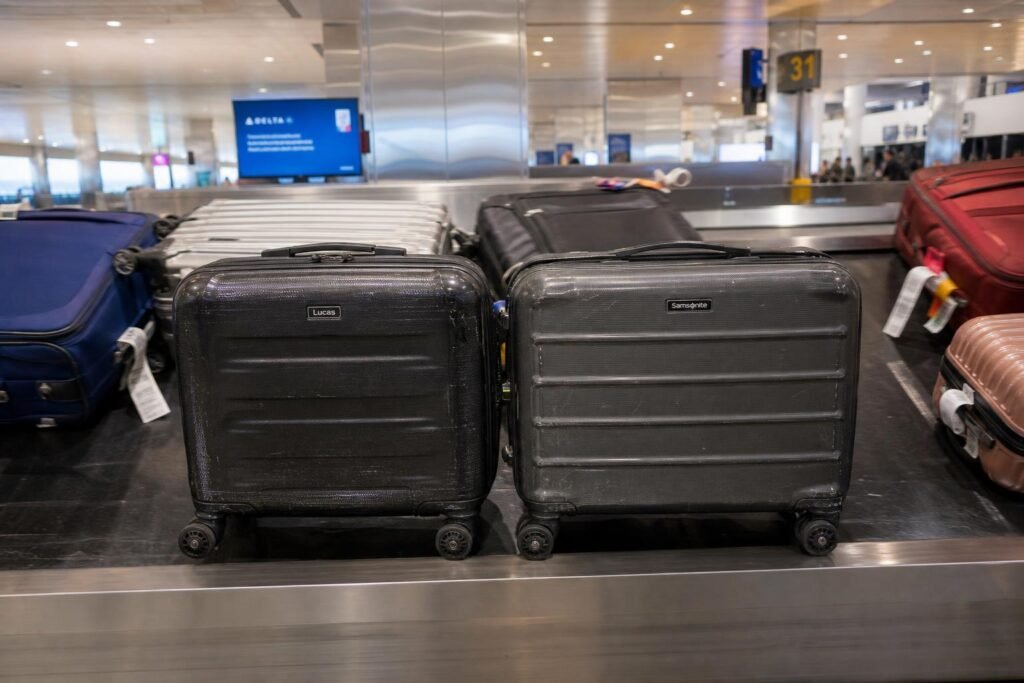
Both bags among other luggage on moving belt — showing how they handle real airport conditions, wheel positioning, scuff patterns after actual travel
You check bags regularly or travel to rough-handling airports. I’ve watched baggage handlers in certain cities treat luggage like they’re personally offended by it. If you’re going through those airports, the Samsonite shell and wheel reinforcement isn’t luxury — it’s practical insurance.
You hate dealing with warranty claims and replacements. Samsonite’s process is smoother, their service centers more common. Lucas technically has a warranty, but enforcing it often means more effort than buying a replacement.
The hybrid approach works too: Lucas for short domestic trips, Samsonite for international or important travel. I know people who keep both, using whichever matches the trip stakes. A Lucas failure on a weekend beach trip is annoying. The same failure before a two-week work trip overseas is a disaster.
One last thing — if you’re still genuinely torn, that probably means either choice works for you. The worst luggage decision is overthinking it so much you delay a trip or overspend on features you’ll never use. Buy what fits your budget now, use it hard, and you’ll know exactly what to upgrade (or not) when it’s time to replace it.